Building or Renovating While Running a Business: How to Plan Your Cash Flow and Budget
This article was written in collaboration with BuildPilot, an Australian home-building platform.
Building or renovating a home is a big financial commitment. For business owners there is an extra layer: your personal finances and your business cash flow have to be planned together.
Your income can move with the seasons, with how quickly clients pay and with one-off business costs. Add a home build or major renovation on top and the pressure on available cash can build quickly if the project hasn’t been planned properly.
With the right preparation, you can go into the project knowing what you can comfortably afford.
Understand your real financial position first
Before you sign a building contract, look at your personal and business finances together.
The balance in your business bank account isn’t the same as money you can spend. Some of it is already committed to GST, PAYG instalments, income tax, wages, super, suppliers and upcoming business costs.
The question isn’t only whether you can cover the deposit or qualify for a construction loan. It’s whether the project stays manageable alongside the ongoing cost of running your business.
Business cash flow and personal cash flow are different
A business can be profitable on paper and still be short of cash. Customers pay late, big expenses land at the same time and quieter months reduce income.
Commit too much to a home project without allowing for this and the pressure lands on the business. Before deciding how much to put towards the project, map out:
- expected business income and expenses over the build period
- tax obligations falling due, including BAS, PAYG instalments and income tax
- your personal commitments
- how the business would cope if revenue dipped or building costs rose
Keeping business and personal finances clearly separated makes each one easier to read.
Budget for more than the building contract
Most people start with the builder’s quoted price. The total project cost is usually more than that.
Depending on the project, extra costs can include design, engineering, approvals, site works, selections, variations, landscaping, fencing, driveways and other finishing works. Renovations add more uncertainty, because opening up existing structures can reveal problems nobody could see when the job was quoted.
Rather than committing every available dollar, keep a contingency so you have room to move if circumstances change.
Know when construction payments fall due
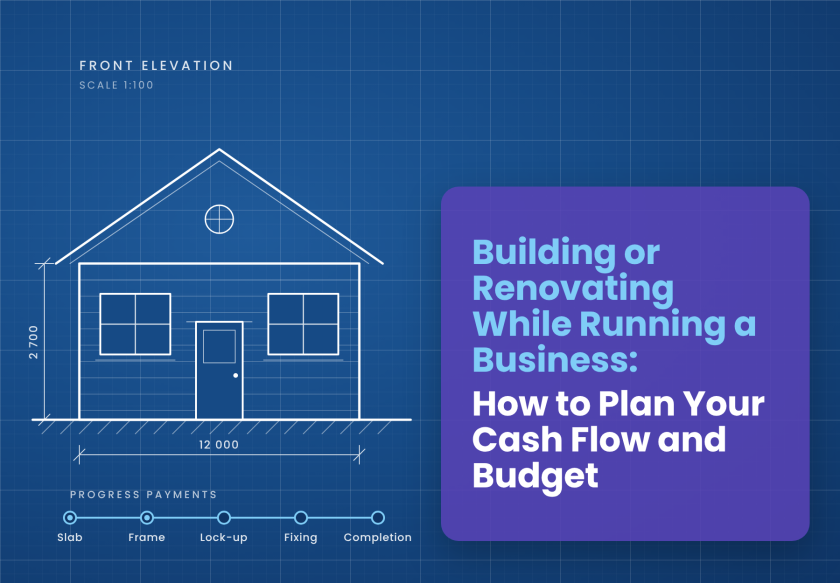
New home builds are usually paid through progress payments rather than one upfront amount. These are commonly linked to stages such as slab, frame, lock-up, fixing and completion, although the exact schedule depends on your contract. Renovations can follow different payment schedules depending on the scope of work.
For business owners, the timing matters. A progress payment can land in the same month as a BAS, a tax bill or a quiet trading period.
Lay the expected construction schedule over your business cash flow forecast to spot the tight months early. If you’re using finance, your lender may also have requirements around progress payments, your own contribution and when construction funds are released.
Taking money out of your business to fund the build
How you take money out of your business to pay for a home project matters, and the answer depends on your structure.
- Sole traders: drawings aren’t taxed on their own, because you and the business are the same taxpayer and tax is worked out on the business profit. The risk is cash flow: make sure enough is set aside for your tax bill and PAYG instalments before money goes to the build.
- Companies: money taken from a private company for personal use, including paying a builder straight from the company account, can be treated as an unfranked dividend under Division 7A unless it is handled properly. That usually means a complying loan agreement in place before the company’s lodgment day, or taking the money as wages or dividends instead. Our article on Division 7A explains how this works.
- Trusts: drawing funds from a trust, particularly one with unpaid entitlements owing to a company beneficiary, can also bring Division 7A into play.
Also keep private building costs out of the business books. GST credits and tax deductions generally aren’t available for building or renovating your own home, and coding those costs to the business creates problems at tax time.
Talk to us before you move large amounts out of the business. It is much easier to set this up correctly at the start than to fix it after year end.
Keep your business commitments in view
A build can run for months, and business conditions can change a lot in that time. Equipment may need replacing, you may need to hire, suppliers may raise prices or an opportunity may come up that needs cash.
That doesn’t mean putting the home project off. It means making the decision with the whole picture in front of you. For more complex situations, it can also be worth bringing in a finance broker or other qualified adviser.
Track the building budget separately
Once construction starts, progress payments, variations, upgraded selections and unexpected costs can shift the budget week by week. If you’re already managing business finances, a separate system for the build makes it much easier to see where the money is going.
BuildPilot is an Australian home-building platform with an app that includes tools to manage your project budget and keep track of each stage of construction. We look after the accounting side, and BuildPilot covers the building process itself.
George Giannakakis, Founder of BuildPilot, says understanding the full project budget is one of the most important parts of planning a home build:
“When people start building, they naturally focus on the price of the house. But the real cost of the project can involve much more than that. For business owners especially, it’s important to understand what the entire project is going to cost and how those commitments fit into everything else they have going on financially.”
The bigger picture
Building or renovating should be an exciting milestone. For business owners, it has to work alongside the responsibilities of running a business.
Look at the complete financial picture, not the building contract or the business bank balance in isolation. The goal is to build or renovate the home you want without putting unnecessary pressure on the business you’ve worked hard to establish.
Frequently asked questions
Can I use money from my business to build my home?
It depends on your business structure. For companies, and some trusts, taking money out for personal use can trigger Division 7A and be taxed as an unfranked dividend if it isn’t handled correctly. Speak with your accountant before using business funds for personal expenses.
How should business owners budget for a new home build?
Allow for the complete project cost, not just the building contract. Then weigh it against your available personal funds, finance arrangements, business cash flow, tax obligations and a contingency for unexpected costs.
Can fluctuating business income affect construction finance?
It can. Lenders generally assess income, liabilities and overall financial circumstances, and requirements vary between lenders, particularly for self-employed borrowers. A finance broker can help you understand what lenders will look for.
Should I speak with my accountant before renovating?
For significant projects, yes, particularly where the project affects your personal savings, your business cash flow or how you take money out of the business.
We hope you’re enjoying our blog, just a note though. The information provided here is intended for general informational and educational purposes only. While we aim for accuracy, we can’t guarantee that this content will apply to your specific situation, every business owner’s circumstances are unique.
This blog is not a substitute for personalised advice from a qualified accountant, tax advisor, or any other professional. It is not financial product, credit or legal advice. If you have questions specific to your individual circumstances, we strongly recommend consulting a professional for tailored advice.